

Breathing Circuits Made Simple: Which Circuit, How Much Oxygen

The rule of thumb is simple: small patients (below about 5 kg, including most cats, toy dogs and birds) go on a non-rebreathing circuit with high oxygen flow; larger patients go on a rebreathing (circle) circuit with low flow. This article explains why, and how to set the flow.
Rebreathing vs non-rebreathing at a glance
| Rebreathing (circle) | Non-rebreathing (T-piece, Bain, Mapleson types) | |
|---|---|---|
| Typical patient | Above about 5 kg | Below about 5 kg, birds, small exotics |
| How CO2 is removed | Soda lime / CO2 absorbent | High fresh gas flow washes it out |
| Fresh gas flow | Low (cheaper, warmer, more humid gas) | High (more oxygen and agent used) |
| Resistance to breathing | Higher (valves, absorbent) | Very low |
| Speed of depth change | Slower at low flows | Fast: inspired gas = vaporizer setting |
| Key risk | Exhausted absorbent, stuck valves, closed APL | Too little flow causes CO2 rebreathing; never use the oxygen flush |
The 5 kg cut-off is a guide, not a law. A healthy 6 kg cat does well on either; a weak 4 kg dog may benefit from the low resistance of a non-rebreathing circuit.
Setting fresh gas flow
Normal minute volume in dogs and cats is roughly 200 mL/kg/min (tidal volume about 10–15 mL/kg × breathing rate).
Rebreathing (circle) circuit
- Induction, or when you need to change depth quickly: 50–100 mL/kg/min.
- Maintenance: 20–40 mL/kg/min (low flow). Do not go below about 0.5 L/min on most machines.
- At low flows the circuit lags behind the dial. To deepen quickly, raise both the flow and the dial for a few minutes.
Non-rebreathing circuit
- Use about 2–3 × minute volume, in practice 400–600 mL/kg/min, with a minimum of about 0.5–1 L/min even in very small patients.
- With capnography, inspired CO2 above zero (a baseline that does not return to 0) means the flow is too low or the circuit is faulty.
Worked example – 4 kg cat on a T-piece: minute volume 4 × 200 = 800 mL/min; × 2.5 = 2 L/min oxygen.
Worked example – 25 kg dog on a circle: induction 25 × 75 ≈ 1.9 L/min; maintenance 25 × 30 = 0.75 L/min.
Choosing the reservoir bag
The bag should hold about 5–6 tidal volumes, roughly 60 mL/kg. Round up to the next bag size.
| Patient weight | Approx. bag size |
|---|---|
| Under 3 kg / birds | 0.25–0.5 L |
| 3–7 kg | 0.5 L |
| 7–15 kg | 1 L |
| 15–30 kg | 2 L |
| 30–50 kg | 3 L |
| Over 50 kg | 5 L |
A bag that is too big hides small breaths; one that is too small empties before the breath is finished.
Common circuit mistakes
- Leaving the APL closed after a manual breath.
- Using the oxygen flush with a cat or bird on a non-rebreathing circuit.
- A circle with exhausted absorbent: rising end-tidal and inspired CO2, fast breathing, red mucous membranes.
- Large dead space: long connectors or an oversized mask on a small patient. Cut the endotracheal tube to end at the incisors.
- Forgetting to turn on scavenging.
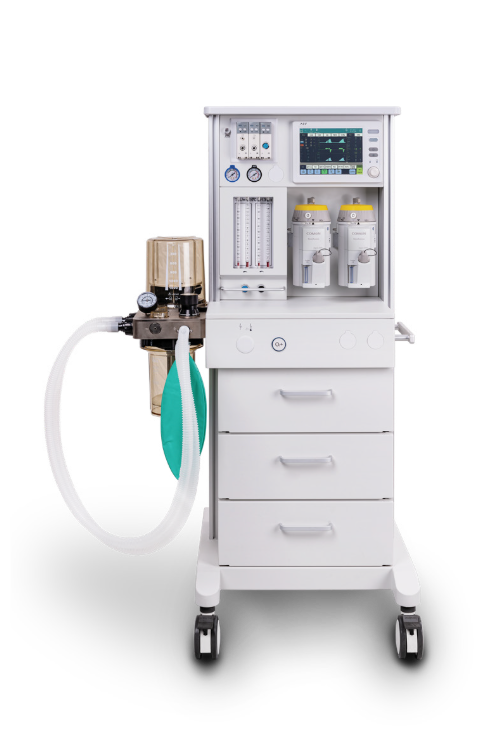
Equipment note from Raed Alsharq: Comen anesthesia machines support both rebreathing and non-rebreathing setups, with an auxiliary gas outlet on the ARK5 and above. We can advise on circuits, bags and connectors for cats, small dogs and birds. Contact us.
This article is for veterinary professionals and is educational only. Flows are starting points; adjust to the patient and your equipment.