

Know Your Anesthesia Machine: From Oxygen Cylinder to Patient

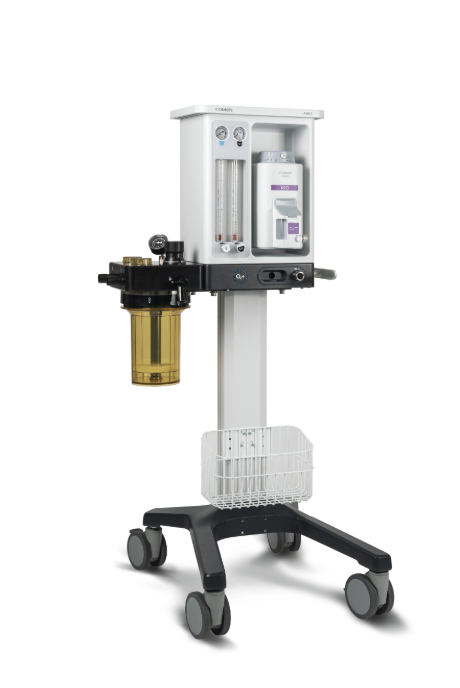
Every anesthesia machine, from a compact clinic unit to a full workstation, does the same job: it delivers a controlled flow of oxygen with a precise percentage of anesthetic, and removes waste gas. If you can follow the gas path, you can troubleshoot almost any problem.
The gas path, step by step
- Oxygen source – cylinder or central pipeline. Check cylinder pressure before every list.
- Pressure regulator – reduces high cylinder pressure to a safe working pressure.
- Flowmeter – sets the fresh gas flow in L/min. Read a ball float at its centre and a bobbin at its top.
- Vaporizer – adds the anesthetic agent at the percentage you dial. It is agent-specific: a sevoflurane vaporizer only takes sevoflurane.
- Common gas outlet – where fresh gas leaves the machine. Some machines have an auxiliary outlet (ACGO) for a non-rebreathing circuit.
- Breathing circuit – rebreathing (circle) or non-rebreathing.
- Patient – via a mask or endotracheal tube.
- APL (pop-off) valve – lets excess gas leave the circuit so pressure does not build up.
- Scavenging – carries waste gas away from staff, actively (suction) or passively (charcoal canister or hose to outside).
Parts that matter most for safety
| Part | What it does | What to watch |
|---|---|---|
| Oxygen flush | Sends a large burst of pure oxygen into the circuit, bypassing the vaporizer | Never flush with a non-rebreathing circuit or a small patient attached: it can rupture lungs |
| APL valve | Releases excess pressure | Must be open during spontaneous breathing. A closed APL is a leading cause of barotrauma |
| Pressure manometer | Shows circuit pressure in cmH2O | Near 0 between breaths; about 10–20 cmH2O when you give a breath |
| CO2 absorbent | Removes CO2 in a circle circuit | Change when the colour change reaches about two-thirds of the canister, or by your hours log. Colour can fade back after resting |
| Reservoir bag | Holds gas, shows breathing, lets you ventilate | Size it to the patient |
| Unidirectional valves | Keep gas moving one way in a circle | Should open and close with each breath; a stuck valve causes CO2 rebreathing |
The 2-minute pre-use check
Do this every day and before each patient:
- Oxygen supply: cylinder pressure adequate, spare cylinder available.
- Flowmeter: turn it on and confirm the float moves smoothly.
- Vaporizer: filled with the right agent, cap closed, seated and locked.
- Absorbent: not exhausted, canister sealed.
- Circuit and bag: correct size for the patient, no holes.
- Leak test: close the APL, occlude the patient end, fill the circuit to about 30 cmH2O. The pressure should hold steady for 10 seconds. If it drops, find the leak (canister seal, vaporizer seat, bag, hoses).
- Open the APL again. This last step saves lives.
- Scavenging: connected and working.
- Monitoring, intubation kit, suction and emergency drugs ready.
Tip: put a printed checklist on every machine and make one person responsible for signing it each morning.
Machine features that make life easier
- Integrated ventilator for long cases, cats, birds and any patient that breathes poorly.
- Small-volume capability (down to about 5 mL tidal volume) if you anesthetize cats, exotics and birds.
- Auxiliary gas outlet to switch to a non-rebreathing circuit for small patients without changing machines.
- Built-in pressure and volume display so you can see what each breath delivers.
Equipment note from Raed Alsharq: The Comen ARK5 is a compact machine for clinics starting with gas anesthesia. The ARK7 adds an integrated turbine ventilator with volume, pressure and assisted modes. The A5-V / A7-V and X6-V / X8-V are full workstations for busier hospitals. Ask us for a side-by-side comparison.
This article is for veterinary professionals and is educational only. Always follow the manufacturer’s instructions for your machine.