

Ventilation Under Anesthesia: When, Why and Safe Starting Settings

All inhalants depress breathing, so many anesthetized patients hypoventilate. Ventilating them, by hand or with a ventilator, keeps CO2 normal, keeps gas delivery steady and makes depth easier to control. In birds, ventilation is close to routine.
When to ventilate
- End-tidal CO2 (EtCO2) above about 55–60 mmHg that does not improve by lightening depth
- Apnea or very slow, shallow breathing
- Open chest, diaphragmatic hernia, or laparoscopy with abdominal insufflation
- Neuromuscular blocking drugs
- Obese, deep-chested or pregnant patients in dorsal recumbency, and long procedures
- Head trauma or raised intracranial pressure (keep CO2 normal)
- Most birds, especially in dorsal recumbency or for longer than a few minutes
Ventilation modes in plain words
| Mode | You set | The machine delivers | Best for |
|---|---|---|---|
| Volume control (VCV) | Tidal volume and rate | A fixed volume; pressure varies | Dogs and cats with normal lungs |
| Pressure control (PCV) | Peak pressure and rate | A fixed pressure; volume varies | Small patients, birds, leaks around uncuffed tubes |
| SIMV | Mandatory breaths, own breaths allowed | Machine breaths synchronized with the patient | Weaning, light planes |
| Pressure support (PSV) | Support pressure | Boosts each breath the patient starts | Spontaneous breathers that breathe too shallowly |
Many modern machines also offer a mode that sets tidal volume from body weight, which helps avoid oversized breaths.
Safe starting settings (healthy lungs)
| Setting | Dog | Cat | Bird |
|---|---|---|---|
| Tidal volume | 8–12 mL/kg | 8–12 mL/kg | Prefer pressure control; watch keel movement |
| Peak pressure | Up to about 15–20 cmH2O | Up to about 12–15 cmH2O | About 8–15 cmH2O |
| Rate | 8–12 /min | 10–15 /min | About 10–15 /min (manual: 1 breath every 4–5 s) |
| I:E ratio | 1:2 | 1:2 | 1:2 |
| PEEP | 3–5 cmH2O | 3–5 cmH2O | Usually not used |
| Target EtCO2 | 35–45 mmHg | 35–45 mmHg | About 30–45 mmHg |
Adjust the rate first to correct CO2, then the volume. A good breath looks like a normal deep breath: the chest (or keel) rises gently, never violently.
Manual ventilation technique
- Close the APL partly (or use a manual occlusion button if fitted).
- Squeeze the bag smoothly while watching the manometer; reach the target pressure over about 1 second.
- Release and re-open the APL if you closed it fully.
- Repeat at the target rate. Count out loud or use a timer.
Watch the side effects
- Lower blood pressure. Positive pressure reduces venous return. Check BP after starting, and avoid high pressures and high PEEP in hypovolemic patients.
- Barotrauma. Keep pressures within the limits above, especially in cats, birds and patients with lung disease.
- Hypocapnia. Over-ventilation (EtCO2 below about 30 mmHg) reduces brain blood flow and delays spontaneous breathing.
Weaning before recovery
- Lighten the plane and give analgesia that does not suppress breathing excessively.
- Reduce the rate so EtCO2 rises toward 50–60 mmHg; this stimulates breathing.
- Switch to SIMV or pressure support if available, then to spontaneous breathing.
- Confirm adequate tidal volume, SpO2 and EtCO2 before turning off the vaporizer.
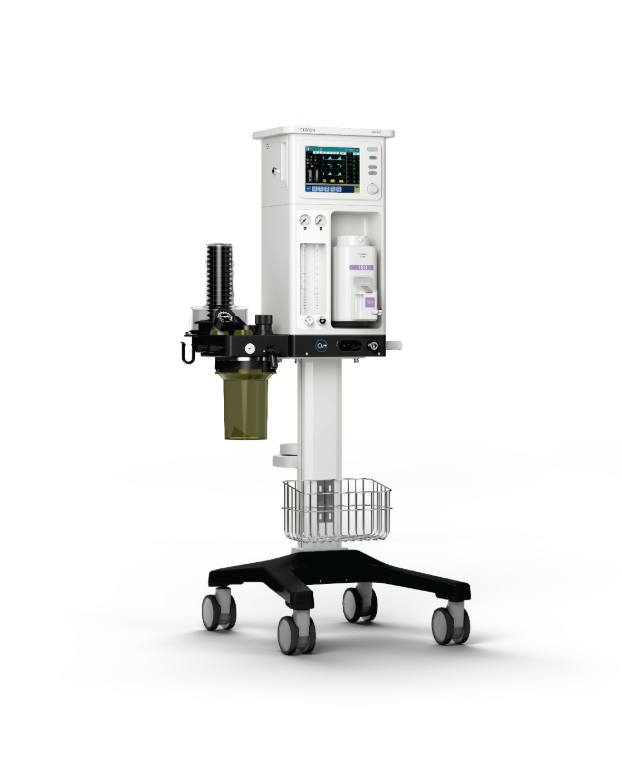
Equipment note from Raed Alsharq: The Comen ARK7 integrates a turbine ventilator with volume control, pressure control and assisted (VS) mode, with tidal volume calculated from body weight and delivery down to about 5 mL, which suits cats and birds. The A5-V / A7-V and X6-V / X8-V workstations are designed for referral and busy hospitals. Contact us.
This article is for veterinary professionals and is educational only. Settings are starting points; adjust to the patient.