

How to Choose a Veterinary Biochemistry Analyzer for Your Clinic

By the Raed Alsharq team · Updated November 2026
A sick cat on the table, a worried owner in the waiting room, and blood results that will take a day to come back from an outside lab. For many clinics, that wait is the main reason to bring biochemistry testing in-house. An in-clinic analyzer lets you check kidney and liver values, glucose and electrolytes during the consultation, and decide on treatment, anaesthesia or referral straight away.
But analyzers differ a lot in how they work and what they cost to run. Here is what to compare before you buy.
1. Start with your caseload, not the brochure
Think about the cases you see every week:
- Wellness and pre-anaesthetic checks need a reliable general panel: kidney values (urea, creatinine), liver enzymes (ALT, ALP), total protein, albumin and glucose.
- Emergency and critical patients need speed, and often electrolytes and blood gases on top of chemistry.
- Chronic patients (kidney disease, diabetes, liver disease) need repeatable results over time, so you can compare one visit with the next.
A clinic that runs a handful of samples a day has different needs from a hospital running dozens. Match the analyzer to your real volume.
2. Panel flexibility
Some analyzers use fixed multi-test rotors or discs: one sample, one disc, a full panel. Others let you choose individual tests. Fixed panels are simple and fast for routine work; flexible menus can be cheaper when you only need one or two values, such as a follow-up creatinine.
Ask which panels are available, whether they are designed for veterinary species, and whether species-specific reference ranges are built in.
3. Sample volume and preparation
Small patients such as kittens, puppies and exotics give small blood volumes. Check how much whole blood, plasma or serum the analyzer needs, and whether it accepts whole blood directly. Fewer preparation steps (pipetting, centrifuging) mean less staff time and fewer handling errors.
4. Time to result
For in-clinic testing to change your decisions, results need to arrive while the patient is still with you. Compare the time from loading the sample to the printed result, and how much hands-on time the technician spends.
5. Accuracy and quality control
Ask the supplier how the analyzer is calibrated, how quality control is done, and how often. Systems with automatic calibration and built-in QC reduce the chance of an unnoticed error. If you already send samples to a reference lab, running a few samples on both is a good way to build confidence in a new analyzer.
6. Running costs
The purchase price is only part of the cost. Compare:
- cost per panel or per test,
- shelf life and storage of consumables (refrigerated or room temperature, which matters in Saudi summers),
- service and maintenance requirements.
7. Local support and training
An analyzer is only useful if it is running. Check who installs it, who trains your team, how quickly a service engineer can reach your city, and whether consumables are kept in stock locally.
8. Room to grow
Many clinics start with biochemistry and later add a hematology (CBC) analyzer, immunoassay, blood gas testing or PCR. Choosing equipment from one platform can make training, data handling and supply simpler.
Our biochemistry analyzers
Raed Alsharq is the exclusive distributor of Seamaty veterinary diagnostics in Saudi Arabia:
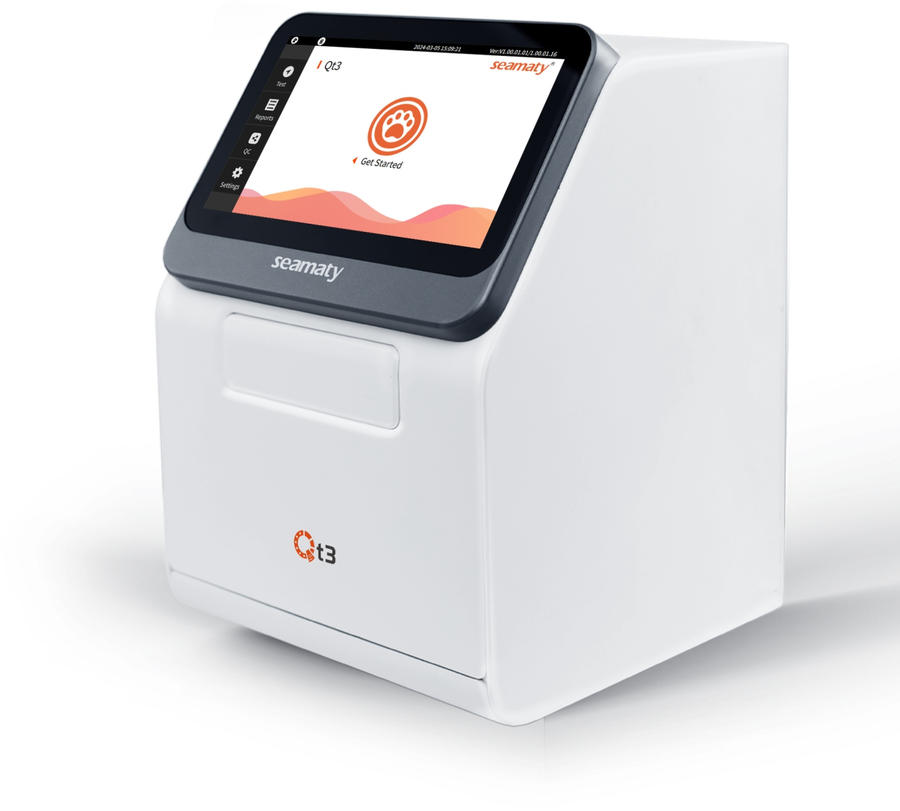
- Seamaty Qt3 – fully automatic veterinary chemistry analyzer for routine in-clinic biochemistry.
- Seamaty VCL1 – biochemistry plus chemiluminescence immunoassay in one system.
- Seamaty Lab 3Dx – all-in-one analyzer combining biochemistry, immunoassay and blood gas testing.
To complete your in-clinic lab, see the Seamaty VBC-50A 5-part hematology analyzer, or read our Veterinary Clinic Setup guide.
Frequently asked questions
Is in-clinic biochemistry accurate enough to replace a reference lab?
For routine panels, modern in-clinic analyzers give results you can act on during the visit. Many clinics still use a reference lab for specialised or unusual tests.
What tests should a basic biochemistry panel include?
At minimum: kidney values, liver enzymes, proteins and glucose. Electrolytes are useful for emergency and critical patients.
Do you provide installation and training?
Yes. Our team covers all regions of Saudi Arabia and supports installation, staff training and consumable supply.
Get a quote
Tell us about your clinic and caseload, and we will recommend the right analyzer for you. Contact us or email info@raedalsharq.com.